Rochester 2GC Replacement Problem

ruffy

New member
Joined
Jun 30, 2013
Messages
28
Reaction score
0
Points
0
Might have got myself in a jam.

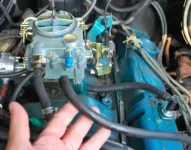
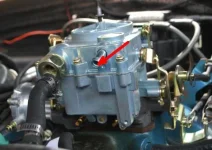
Bought a replacement carb for my 77 Nova 305 that looked almost
exactly like my original Rochester 2GC. Only the vacuum nipple near
the top of the new one (red arrow) seemed to be the only difference,
one that someone had told me I could just plug up.

I removed the old one, mounted the new one, and that's when I
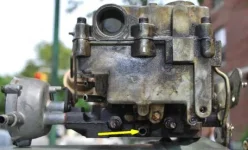
realized ANOTHER difference! The base plate of the old one had
a vacuum nipple whose hose would lead to the charcoal cannister.
(See yellow arrow)

Uploaded pictures of both for you to see.

Aside from the top vacuum nipple in the NEW one, and the other
one, which is missing in the new carb, all other features seem
exactly the same.

Do I call it quits with the new one?
 

Attachments

  • _new_carb.webp
    _new_carb.webp
    25.1 KB · Views: 54
  • _old_carb.webp
    _old_carb.webp
    23.1 KB · Views: 47
if it were my car I would just throw on a Edelbrock 2101 intake and 650 Holley vacuum secondary, you would really have a smile on your face with that combo. Anyway, since you probably want to stay stock any reason why you just dont rebuilt the current carburetor, they are pretty simple to work on?
 
By the time I get a kit, and shop for cleaner and/or cleaning bin, because I have no air
hose/compressor, I'd have to move the car 2 or 3 times. As it is, I spent money already
on this new carb.

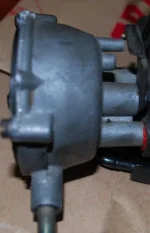
I thought to swap the base plates, but I don't know how to remove the choke from it.
Know how I do that? I opened the choke and the inner coil, but there's no way from in
there to get to the screws that connect to the linkage behind. Looks like the choke is
held with one screw and two contact points where gasket material is sandwiched in.
 

Attachments

  • _choke.webp
    _choke.webp
    15.9 KB · Views: 47
Last edited:
Did the new carburetor work on the car after you installed it, if so just connect the evap canister to the existing fitting on the new carb. I have no manual covering these years so you could try google if you still want to switch parts.
 
It worked. I just have to adjust the mixture screws and the idle-speed screw.
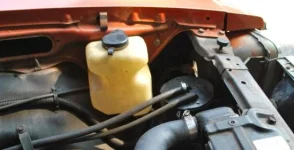
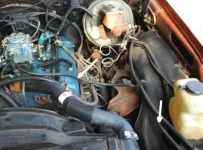
As you see, I'm holding the open-ended tube of one of two that leads to the
charcoal canister, wondering if the port I have capped off (with a blue cap)
is, in fact, a vacuum port.

The other tube of the canister goes to the gas tank, to remove any pressure
therefrom, a friend tells me. Not sure what to do, therefore, about that
open-end of the remaining tube.
 

Attachments

  • _canister.webp
    _canister.webp
    21.5 KB · Views: 54
  • _canister2.webp
    _canister2.webp
    28.3 KB · Views: 56
  • _canister3.webp
    _canister3.webp
    27.3 KB · Views: 49
The way the system works is gas vapors build up in the tank and migrate to the canister. When you run the car those vapors are sucked out of the canister into the carburetor. So start the engine and feel for vacuum at the capped port. If no vacuum raise the engine speed to see if vacuum develops at hight RPM's. If so connect the hose to the port.
 
Back
Top