After Cold Start - Engine Conks Out

ruffy

New member
Joined
Jun 30, 2013
Messages
28
Reaction score
0
Points
0
In the morning, my 77 Nova starts up immediately. But, unless I feed pump
more gas, the engine conks out. When warmed up, the idle does not conk out.

(Just installed a new carburetor, with its new auto choke and inline gas filter.)

Need a good diagnostician to help me out. Thanks.
 
How do you have the choke adjusted? When completely cold is the choke blade completely closed and requires a little pressure to open up? Immediately after it starts does the choke open about a 1/4 inch? have you adjusted the fast idle?
 
Choke works fine. Starts right up.

Readjusted the mixture screws and the idle speed.
Now it only conks out on a warm-start if I don't add a little extra
(unnecessary) rev to it.

I did not check the idle with a tach to set it to spec idle.
But if it were too slow, I would expect it to often conk out,
at stops, which it never does.

Something still isn't right.
 
Not sure how you can accurately adjust mixture screws without a tach or a vacuum gauge. Either idle speed is too low or mixture too lean assuming you dont have a vacuum leak at carb base.
 
Tried to "wing it", Zora. I should do as you suggest.
I'll report back to you. Thanks.
 
Last edited:
You may have too much "closed" pressure on it...
I try to set them where the Choke is barely closed when cold.

Feathering this adjustment is probably the key to getting both (start/run) done.
Your idles should be about 1100 cold, 600 warm.

You sure your Heat tube is clear/open.
Those Idle Mixture adjustments should be done when thoroughly warmed up,
and use a Tach to see what you're doing as zora recommended.
(adjust for maximum RPM)
 
Last edited:
My Rochester 2GC carb doesn't seem have a fast-idle
screw anywhere, to adjust the idle speed on cold start-up.

SWHouston - that "heat-tube" you want me to check, is that
the one that goes into the firewall? (I know one of them goes
inward and the other takes the water back, just not sure
which is which.) AND, how do I check it for inner obstruction.

I was going to replace the coolant in the car anyhow. Maybe
I can do that by cutting the "heat tube" and put therein a
T-tube to flush the system from there? Would that be a good
way to assure no obstruction?
 
he is not referring to the cooling system, he is referring to a hose that typically comes off a 'stove' on the exhaust manifold and connects to the air cleaner providing heated air when the engine is cold. This link explains the fast idle adjustment which is dependant on the warm idle adjustment, you need a tach to get it right.

http://forums.corvetteforum.com/c3-...g-lars-fast-idle-adjust-on-rochester-2gc.html
 
Ok, I admit my Grey Hair got in the way of my Mind's Eye :o (again)

You set the Idle (warmed up) on the lowest step of the Cam at about 600 RPM, and take your chances on what the second step gives you when the Choke moves it into play. You can adjust/bend the Choke Link Rod a little to bring the Fast Idle in a little sooner or later. Also, IF it's really too high, I have filed the second and third steps off a little to make adjustments in the RPM.

Now on the Heat Tube...
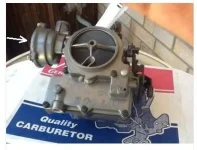
I was referring to a 1/4" Tube with a Female Compression Nut and Ferrule, which comes up from the Intake Manifold and turns (90 deg) directly into the Choke Adjustment Plate. Should be a threaded connector on the Plate for it. You have to loosen that Compression Nut to adjust the Choke.

It should be where the arrow is pointing in the attachment below.
 

Attachments

  • Rochester2GC.webp
    Rochester2GC.webp
    19.9 KB · Views: 100
Last edited:
OK, the choke heater tube, thanks for the clarification.
 
ruffy,

Just FYI, you'll probably have to adjust the Choke setting 3-4 times (seasonal) a year, to keep up with this problem. One of the few reasons why the move to Computer control of this and other issues is positive. I did say few !
 
My Rochester 2GC hasn't got handy choke adjustment screws or the like. Is there some trick way to do this? But if so, why did GM assume that their fixed initial setting should work and remain fixed throughout seasons?
 
Last edited:
Gentlemen, I really appreciate the wisdom of your collective experience.
Gray hairs aside, there's still plenty for me to learn. And there ain't
nothing better than good teachers to learn from.

Houston, how does one determine the choke heater tube's patency,
without taking it apart for inspection? Maybe a good time to do that
would be when I get around to replacing my valve-cover gaskets,
which show some leakage.

But before that, as per Zora's suggestion, I have to 1st and foremost
make sure my idle and mixture settings are set correctly, which I
can't yet do unless I buy a tachometer, which I'm shopping for now.
(I'll also want to get a vacuum gauge to rule out any misfiring or
unsteady vacuum reading. I'm wondering if there's such a thing as a
tach-vacuum cluster of gauges I can one day hook up.)
 
Last edited:
If the choke completely opens after being shut the tube is clear.
 
1) how does one determine the choke heater tube's patency, without taking it apart for inspection?

2) But before that, as per Zora's suggestion, I have to 1st and foremost
make sure my idle and mixture settings are set correctly.

3) tachometer, which I'm shopping for now. (I'll also want to get a vacuum gauge to rule out any misfiring or unsteady vacuum reading. I'm wondering if there's such a thing as a tach-vacuum cluster of gauges I can one day hook up.)

1) Actually there is no way to see if it's open unless you take it off, and blow your breath through it. If you can feel the air coming out the other end, then it's ok. It's just one Nut you have to take loose to get it off the Carb. I don't recall one ever being stopped up.

2) They don't have to be perfect !
Just get your ride warmed up good, and the idle speed set where it sounds ok.
Then take one at a time, turn it CW till you hear the RPM drop, remember where the Screw is at, turn it CCW till the RPM drops again, and split the difference. Do that on both Idle Screws.

3) Tach and Vacuum gauges are great to have, but you can do things without them. You just got to listen to your ride, you can hear if it's close to right ;)

They make Clusters of Gauges (Tach/Pressures/Temps/Volts) that you can hang under your dash or buy those things separately for Diagnostic use. I prefer to have them permanently connected/mounted on my Rides, where I can watch and listen, and really get to know how things feel at a given reading.

As accurate as Digitals are, I still prefer the Analogs :D
 
Last edited:
From my experience(except for my factory brand new 1974 Chevy Nova) all engines from the 70s had idle, choke, kill issues. My wife had a 74 Dodge Charger that would kill at every stop light and not even the Dodge dealer's mechanics could fix it. I also had a 1974 Chevy 4x4 Cheyenne pickup that was the same way, would not idle and killed all the time. The automatic chokes back then seemed to be a joke. I would have much rather had a manual choke with a wire running to a knob on the dash. Is there available today an alternative to the Rochester carbs, something with electronic choke control? I am in the middle of pulling 250 six out of my 1974 Nova and installing an early 70's 350. I am dreading the choke, idle kill issues all over again. With fingers crossed maybe this 350 with 4 bbl Rochester will run like a swiss watch.:cool:
 
If the Quad is properly adjusted you should have no issues. That involves both the choke tension and choke pull off and fast idle.
 
Back
Top